

1. The Acropolis Museum. The Acropolis Museum is consistently rated as one of the best museums in the world, both for its contents and its design. The detail of the exhibits and sculptures on display is astonishing. The Acropolis Museum is primarily devoted to exhibiting artifacts that were unearthed in or around Acropolis Hill and the Parthenon in Athens, yet its collection also extends to historical objects from other sites in the greater Attica region.
The culmination of the Museum’s carefully crafted exhibition plan resides on the third floor of the museum which is devoted exclusively to the sculptural decoration of The Parthenon, the largest temple of the Acropolis. We suggest that you begin your journey here, making your way down as you explore the museum.
Must see:
- The Archaic Gallery (700-480 BC). The Gallery hosts the magnificent sculptures that graced the very first temples on the Acropolis, and visitors have the opportunity to view the three-dimensional exhibits from all sides. With the benefit of the ever-changing natural light, visitors can discern and discover the delicate surface variations of sculptures, selecting the best vantage point from which to observe the exhibits.
- The Caryatids (420-415 BC). On the first floor you will find five Caryatids that supported the roof of the south porch of the Erechtheion, instead of columns. Replacing the columns with female statues was a common Greek architectural practice.
- The Hekatompedon (570 BC). Its name, literally meaning “100 feet” in Greek, was inscribed on an ancient tablet found buried in the ancient site. The pediment’s preserved sculptures comprise three distinct groups that depict various mythical conflicts, such as Heracles wrestling a mythological beast.
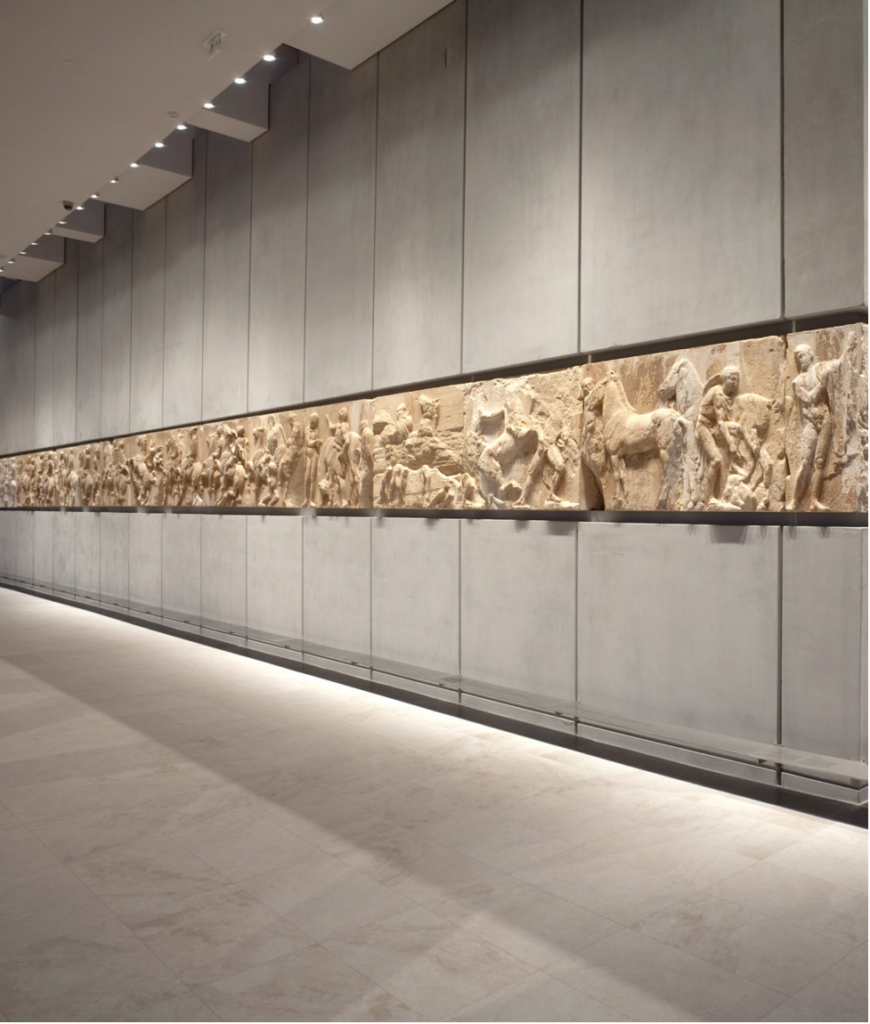
- The Frieze (443 -438 BC). The Parthenon Frieze on the 3rd floor forms a continuous band, with scenes in relief that encircle the upper part of the cella, or main temple, within the outer colonnade. The frieze displays the procession of the greatest festival that took place in ancient Athens, the Panathenaia, including 380 human figures of men and women, pedestrians, horse riders and charioteers, as well as 200 animals, objects and offerings to the goddess Athena, protectress of Athens.
Temporary exhibitions in the purpose-built gallery enrich the exhibition program over and above the magnificent permanent collection, and the Museum auditorium and lounge enables visitors to obtain further information and resources about life on the ancient Acropolis.
On average, visitors spend around 1.5 hours in the museum. Our recommendation is to devote 2h -2 ½h in the museum, in order to view the exhibits at a leisurely pace. Skip line e-tickets are always a great idea!
Located on the Museum’s second floor, the restaurant features panoramic views of the Acropolis and other historic hills of Athens, especially if you sit on the terrace.
Greece can be very hot in the summer with temperatures in Athens commonly reaching 30° Celsius, thus we suggest an early morning visit to the Acropolis, and then a visit to the air-conditioned museum as the temperature rises. If hot weather is not an issue, the museum is typically less crowded early in the morning or a few hours before closing.
https://www.theacropolismuseum.gr/en Just 300m from the Parthenon, Metro station: Acropolis



2. The National Archeological Museum stands out as an elegant example of neoclassical architecture. The building that houses the museum used to house the Greek Parliament and then the Ministry of Justice, and was designed by the German architect Ernst Ziller. Its construction was completed in 1889.
The museum’s five large permanent collections house more than 20,000 exhibits, providing a panorama of Greek civilization from the beginnings of Prehistory through to Late Antiquity.
Must see:
- The statues of Kore & Kouros, (around 550-540BC): Both are fully preserved and considered among the most important pieces of archaic art in existence,
- Artemisio Bronze, the bronze statue of Zeus or Poseidon (around 460BC): The statue is slightly bigger than life-size at 209 cm, and would have held either a thunderbolt, if Zeus, or a trident if Poseidon,
- The Antikythera Mechanism (circa 200BC): Regarded as the oldest example of an analogue computer. This small bronze instrument is unique because it precedes any machine of comparable complexity by more than a millennium,
- The golden death mask of Agamemnon (Scientists have dated the mask back to the 16th century BC): It was found over the face of a body in a burial shaft in the Mycenaean Citadel,
- Jockey of Artemision statue (around 140 -150 BC): This bronze masterpiece was found in pieces at different times and was subsequently pieced together.
The Archaeological Museum lies within walking distance of Omonoia or Victoria metro stations. It is open every day, and features a beautiful and cozy cafe in the museum’s patio. https://www.namuseum.gr/en/


3) The Museum of Cycladic arts is housed in two separate buildings which are connected by a glass-roofed corridor: the Main Building houses the permanent collections and the New Wing, and the Stathatos Mansion next door houses the temporary exhibitions. The museum was inaugurated in 1986 and houses one of the most complete private collections of Cycladic art worldwide. It features a 5,000-year-old artwork collection with high quality figurines of marble, vases, tools, weapons and pottery from all phases of the distinctive Cycladic Island culture that flourished in the central Aegean during the Early Bronze Age (third millennium BC).
The first floor houses the Cycladic Art Exhibition that includes a large number of high-quality marble figurines and vases, some of the earliest known bronze objects in the Aegean, and pottery for both every day and ritual use, most of which are circa from the 3rd millennium BC. Although Cycladic marble figurines and vases appeal to the modern viewer for their almost translucent whiteness, their creators loved color and used it extensively on these objects for both practical and symbolic reasons.
The collection of Ancient Greek Art on the second & fourth floors is comprised of painted vases, terracotta figurines, bronze vessels, stone sculptures, coins, gold jewelry and glass items, covering time spanning from the 2nd millennium BC to the 4th c. AD. The exhibition provides an overview of historical, artistic and technological developments over the course of ancient Greek history. The exhibition on the 4th floor offers a vivid look into everyday life in Classical Athens, accompanied with rich educational material.
The Cypriot Art exhibition is one of the most comprehensive collections of Cypriot antiquities in the world. It contains more than 800 objects that help visitors to learn about the history of the island, and its relations with other regions of the eastern Mediterranean from the 4th millennium BC to the Early Christian period (6th c. AD).
The Museum of Cycladic Art is not only one of the best-known museums in Athens, but it’s also one of the most interesting.
https://cycladic.gr/en / Metro Station: Evangelismos (6m walk). From Syntagma square is 12min walk.


