
Exarchia is bordered by the upscale neighborhood of Kolonaki and Omonia Square, and is notorious for its reputation as a leftist and anarchist stronghold, having long been a hub of radicalism and counterculture. But at the same time, Exarchia is also known as a bohemian enclave where students, intellectuals, artists and long-standing residents navigate their everyday chores with a rebellious spirit.
Similar to the district of Plaka, Exarchia was initially inhabited by migrants from the Cycladic islands. Still, the area only began developing its distinct identity when the University of Athens decided to relocate a few of its departments to the new district.
In the mid-1970s, the students of the University at Exarchia were on the frontline of the city’s uprising against the dictatorship regime, which resulted in overthrowing the junta and further cemented the area’s character as being restless and rebellious.

Exarchia defines Athens’ alternative cultural scene. In fact, the neighborhood is one big urban museum, where you can view the works of many street artists. Virtually every wall, alley, storefront and spare surface has been turned into a canvas with thought-provoking graffiti. Much of the street art communicates political messaging, especially in the quadrant defined by Metaxas, Benaki, Tzavella, and Mesolonggiou streets.

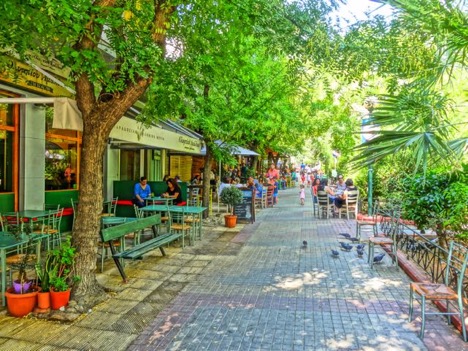
If one day during your stay in Athens, if you want to explore past the mainstream Plaka area, a visit to Exarchia could be just what you need. You can start off by walking around Exarchia Square and getting acquainted with its unique vibe. Grab a bite at one of the numerous food spots that serve almost everything – from the traditional souvlaki and spanakopita to ethnic cuisine and high-end fusion culinary treats. Go treasure hunting at the vintage shops and record stores, and then head off to explore the city’s art scene at one of the many contemporary galleries based in Exarchia.
Currently, much construction and gentrification has influenced this famous neighborhood, but there is still much work to be done.

Combine “anarchy” with culture by visiting one the Greatest museums in the WORLD: The National Archaeological Museum.
At the far end of Exarchia, the National Archeological Museum stands out as an elegant example of neoclassical architecture. The building that houses the museum used to house the Greek Parliament and then the Ministry of Justice, and was designed by the German architect Ernst Ziller. Its construction was completed in 1889.
The museum’s five large permanent collections house more than 20,000 exhibits, providing a panorama of Greek civilization from the beginnings of Prehistory through to Late Antiquity.
Five things you must to see at the museum. 1) The statues of Kore & Kouros, (around 550-540BC): Both are fully preserved and considered among the most important pieces of archaic art in existence. 2) Artemisio Bronze, the bronze statue of Zeus or Poseidon (around 460BC): The statue is slightly bigger than lifesize at 209 cm, and would have held either a thunderbolt, if Zeus, or a trident if Poseidon, 3) The Antikythera Mechanism (circa 200BC): Regarded as the oldest example of an analogue computer. This small bronze instrument is unique because it precedes any machine of comparable complexity by more than a millennium, 4) The golden death mask of Agamemnon (Scientists have dated the mask back to the 16th century BC): It was found over the face of a body in a burial shaft in the Mycenaean Citadel, 5) Jockey of Artemision statue (around 140 -150 BC): This bronze masterpiece was found in pieces, at different times and was subsequently pieced together.
The Archaeological Museum lies within walking distance of Omonoia or Victoria metro stations. It is open every day, and features a beautiful and cozy cafe in the museum’s patio. https://www.namuseum.gr/en/